
How we work
Our Approach
Good infrastructure decisions are made in order. Every engagement moves through seven stages, and each ends in a recorded decision.
We start with the infrastructure challenge and assess the options against evidence, site conditions and commercial requirements.
Our method
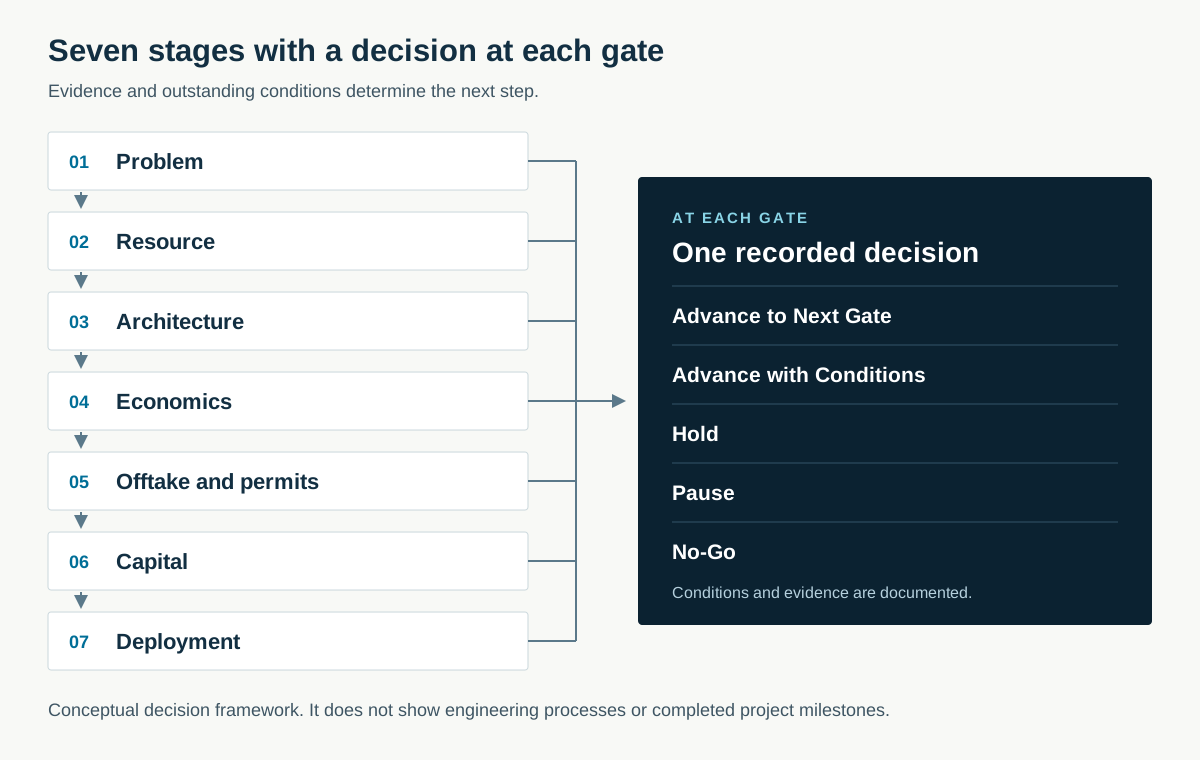
Seven stages with a
decision at each gate
Each stage addresses a different question. The evidence and outstanding conditions inform whether the opportunity advances, needs further work or should stop.
The seven stages
- Problem — define the constraint and operating baseline.
- Resource — review available inputs, demand and site evidence.
- Architecture — compare suitable technology and integration options.
- Economics — test assumptions, costs and sensitivities.
- Offtake and permits — establish customers and the approval pathway.
- Capital — assess financing options and their conditions.
- Deployment — define delivery, ownership and operating arrangements.
The five gate decisions
- Advance to Next Gate — the evidence supports the next stage.
- Advance with Conditions — proceed once stated conditions are met.
- Hold — more evidence is needed before deciding.
- Pause — an external factor must be resolved first.
- No-Go — the evidence does not support proceeding.
An assessment supports a decision. It does not authorise construction, commit finance, establish bankability or validate a technology.
Stage by stage
What each stage asks
- 01
Problem
What constraint are we solving, and what does it cost?
You receive: Problem definition and baseline
- 02
Resource
What load, heat, feedstock and site are actually available?
You receive: Resource and site evidence summary
- 03
Architecture
Which technologies fit, ours or others?
You receive: Technology-neutral options comparison
- 04
Economics
Does it work, and under what conditions?
You receive: Preliminary economics and sensitivities
- 05
Offtake and permits
Who buys the output, and what approvals are needed?
You receive: Offtake and permitting pathway
- 06
Capital
What capital structure could fund it?
You receive: Capital architecture options
- 07
Deployment
How would it be built, owned and operated?
You receive: Delivery and SPV structure
Governance
Who decides
OceanBlocks® uses a stage-gated project review process. Proposed developments are evaluated against technical feasibility, resource and site evidence, preliminary economics, counterparties, regulatory requirements, financing and delivery risks. Decisions and outstanding conditions are documented to support accountability and disciplined capital allocation.
Decision support
What a gate decision is not
An assessment supports a decision. It does not authorise construction, commit finance, establish bankability or validate a technology.
We will recommend against a project when the evidence points that way.
Next step
Tell us about the
infrastructure challenge.
We review each enquiry and respond when we have enough information to identify an appropriate next step.